Railway Station Alarm Clock
About
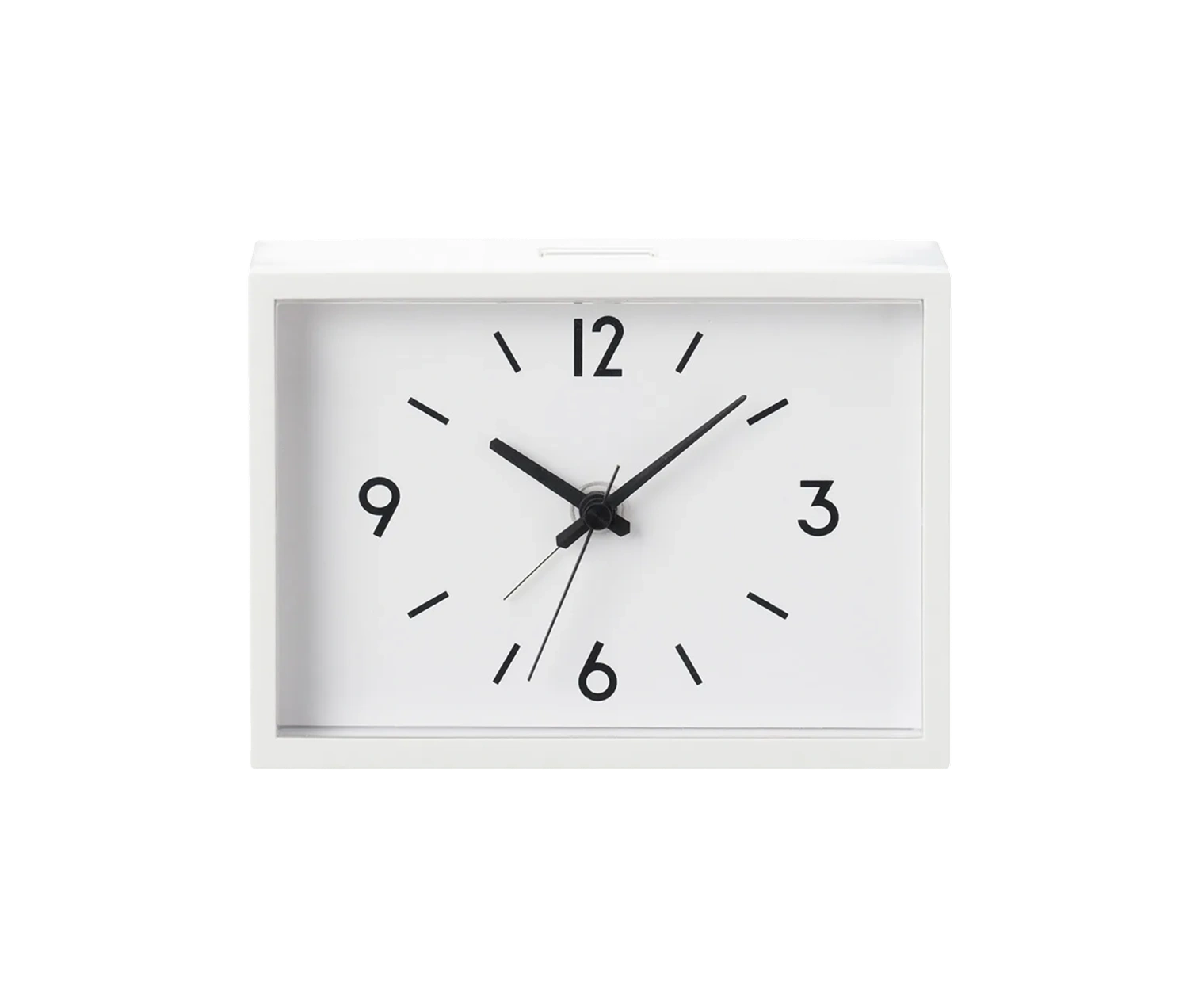
Train station clocks evolved under demanding legibility requirements: passengers needed to verify departure times instantly, from distance, in crowded and poorly lit environments. Japanese railway operators refined this utilitarian typography over generations, developing dial designs that communicate time with maximum clarity and minimum distraction. Muji translated these principles into a bedside format, preserving the essential characteristics while scaling proportions appropriately for domestic distances.
The dial presents bold numerals and thick hour markers against a pale background, creating contrast that remains legible across bedroom dimensions and during the partial darkness of early morning waking. Hands maintain proportional weight that matches index graphics, avoiding the spindly fragility common to decorative clocks. This visual consistency enables time reading at a glance, without the cognitive processing that competing dial elements can demand.
The case employs matte white plastic that absorbs rather than reflects ambient light, preventing the distracting glare that glossy surfaces produce from bedside lamps or morning sun. This surface treatment also allows the clock to recede visually, supporting interior compositions rather than asserting independent presence. The alarm mechanism provides reliable wake-up function, the essential utility that justifies bedside placement. Dimensional proportions suit nightstands without overwhelming available surface area. For those who prefer analog displays to phone screens and seek design that serves function transparently, this clock offers essential timekeeping distilled to its clearest expression.