Royal Oak
About
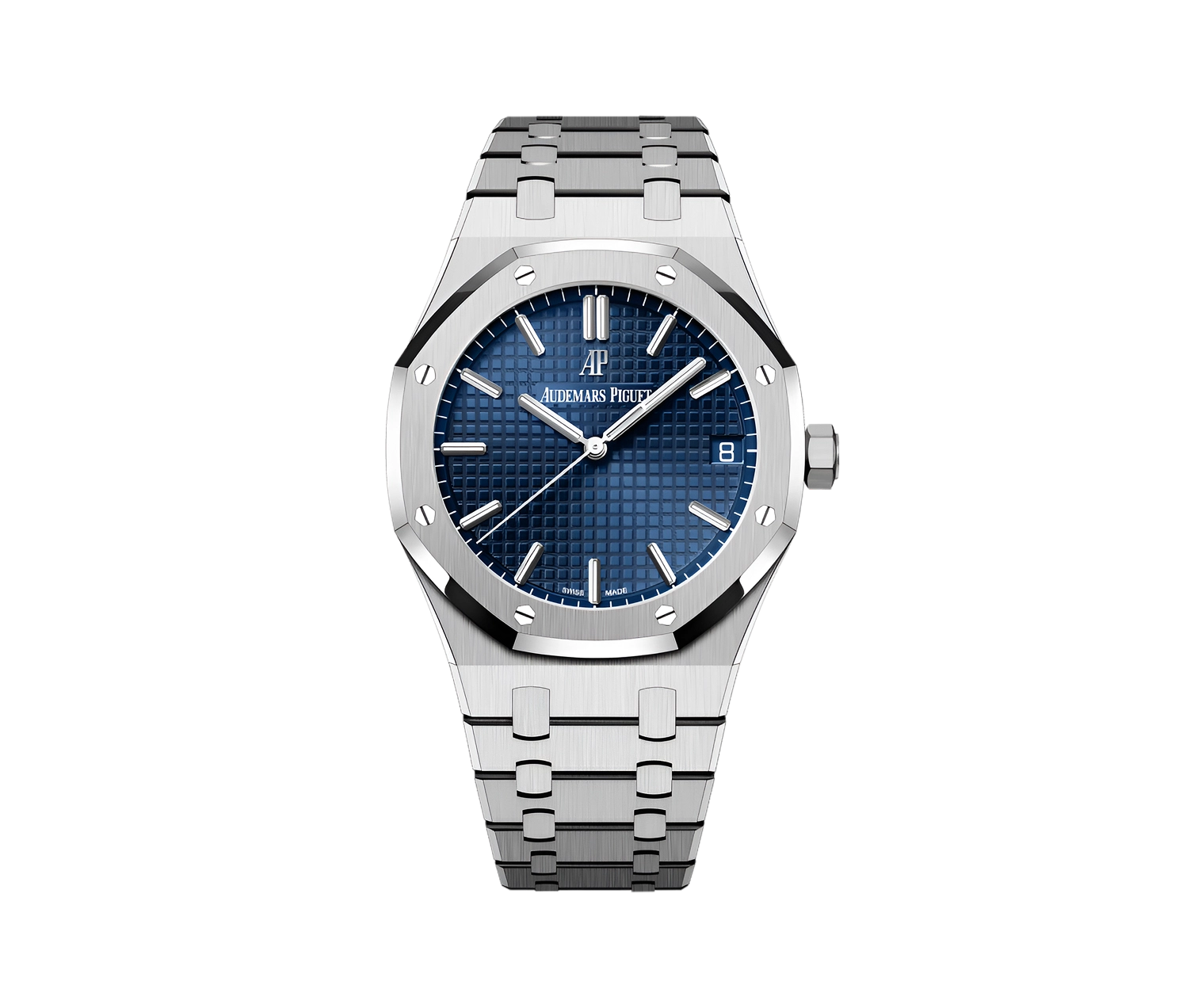
Gerald Genta's 1972 design for Audemars Piguet redefined expectations for what a luxury sports watch could be, and the Royal Oak continues to embody that original provocation. The octagonal bezel arrives as the defining gesture, eight sides secured by eight visible hexagonal screws that reference industrial hardware while achieving jewel-like precision. These screws sit flush with the bezel surface, their slots aligned with the obsessive consistency that marks haute horlogerie finishing.
Surface treatments across case and bracelet alternate between horizontal brushing and mirror polishing, creating a visual dialogue between matte and reflective planes. This interplay animates the watch under changing light conditions, revealing new facets as the wrist moves through daily gestures. The integrated bracelet extends from the case without visible transition, each link shaped to continue the angular vocabulary established by the bezel while articulating smoothly around the wrist.
The dial employs the signature Tapisserie pattern, a grid of small raised squares that produce texture and depth. This guilloche-inspired motif captures ambient light differently depending on angle, lending the face a liveliness that flat dials cannot achieve. Hands and hour markers receive applied finishing, with luminous material ensuring legibility in reduced light. The movement visible through the exhibition caseback demonstrates Audemars Piguet's commitment to mechanical excellence, with decoration that rivals the exterior. Fifty years after its introduction, the Royal Oak remains simultaneously recognizable and contemporary, a design so resolved in its initial conception that subsequent iterations refine rather than reinvent. For collectors and enthusiasts, it represents both historical significance and enduring relevance.